WhatsApp Business Marketing in India: The Complete SME Strategy for 2026
India has more WhatsApp users than any other country on earth, and for most Indian consumers it is not a secondary app — it is the first place they check in the morning and the last place they check at night. Yet walk through the marketing plan of almost any small or mid-sized Indian business and you will find a Google Ads budget, an Instagram calendar, maybe an email tool — and no real WhatsApp strategy at all.
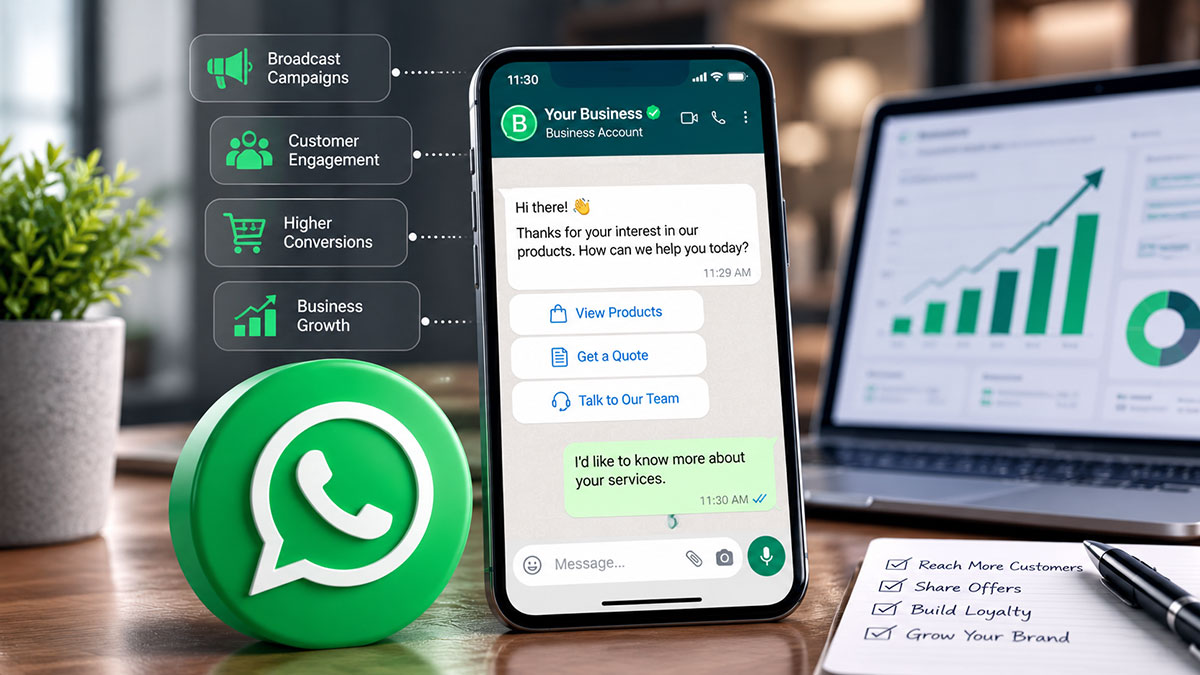
That gap is the opportunity. WhatsApp Business and the WhatsApp Business API are no longer just a customer support inbox; used correctly, they are a direct, high-open-rate marketing channel that consistently outperforms email and even paid social for Indian audiences. This guide breaks down exactly how SMEs in India can build a compliant, automated, and genuinely effective WhatsApp marketing strategy in 2026.
Why WhatsApp Beats Email and SMS for Indian Audiences
Open rates tell the story on their own. Marketing email in India typically struggles to clear 20% open rates, and SMS is treated as spam by most recipients before they even read it. WhatsApp messages, by contrast, are routinely opened within minutes because the app itself is checked so frequently and because a WhatsApp notification still feels personal rather than promotional.
There is also a trust dimension unique to the Indian market. Customers already use WhatsApp to talk to their doctor, their tailor, their child’s school, and their bank’s relationship manager. A business that shows up in that same thread — with a verified green tick, a clear display name, and a professional catalog — inherits some of that trust automatically, provided the business does not abuse it with spammy broadcasts.
WhatsApp Business App vs the WhatsApp Business API
The free WhatsApp Business App is fine for a single-location shop handling a manageable volume of chats manually — it offers a catalog, quick replies, labels, and basic automated greeting and away messages. It does not scale, however, because it is tied to one phone and one device, and it cannot integrate with a CRM.
The WhatsApp Business API is the real growth lever. It allows multiple team members to respond from one number, connects to CRMs and automation tools like n8n, supports pre-approved marketing templates for outbound campaigns, and unlocks green-tick verification for established brands. For any SME doing more than a handful of conversations a day, or planning to run broadcast campaigns, the API is the correct starting point rather than something to graduate into later.
Building a Compliant Broadcast and Campaign Strategy
Meta’s policies around WhatsApp marketing are strict for good reason, and getting them wrong can get a business number banned. Every marketing message sent outside a 24-hour customer service window must use a pre-approved template, and every recipient must have given explicit opt-in — a checkbox on a website form, a QR code at a physical counter, or a reply to a click-to-WhatsApp ad all count; a purchased contact list does not.
The most effective campaign structures Netnovaz sees for Indian SMEs mix three message types: transactional templates (order confirmations, appointment reminders) that build trust and keep opt-out rates low, utility broadcasts (restock alerts, price drops) that drive direct sales, and light-touch relationship messages (festival greetings, loyalty milestones) that keep the brand present without feeling like spam. Segmenting the contact list by purchase history or engagement, rather than blasting the entire list every time, is what separates a channel that grows into one that gets muted.
Automating WhatsApp with AI and n8n
The real ceiling on WhatsApp marketing for most SMEs is not the channel, it is manpower — someone has to answer every inbound message quickly or the opportunity is lost. This is where automation changes the economics entirely. Workflow tools like n8n can connect the WhatsApp API to a business’s product catalog, CRM, and order system so that common questions (pricing, stock, delivery timelines) are answered instantly, 24/7, without a human typing a single reply.
Layering an AI agent on top of that automation takes it further: instead of rigid keyword-triggered replies, the AI can hold a natural conversation, qualify the lead by asking clarifying questions, and only escalate to a human team member when the conversation reaches a genuine buying decision or a complaint. Businesses that have implemented this typically report faster response times, more consistent lead qualification, and considerably lower cost per conversion than paid social campaigns driving the same volume of conversations.
Measuring What Actually Matters
Vanity metrics like messages sent are close to meaningless on their own. The numbers worth tracking are delivery rate, read rate, reply rate, opt-out rate per campaign, and — most importantly — conversion rate from a WhatsApp conversation to an actual sale or booking. A campaign with a lower open rate but a higher conversion rate is doing its job better than one that looks impressive on a dashboard but converts nobody.
Most WhatsApp Business API providers expose this data natively, and connecting it to a CRM makes it possible to see, over a quarter, exactly which segments and message types are producing revenue rather than just activity.