IT Outsourcing vs In-House IT: Which is Right for Your Business in 2026?
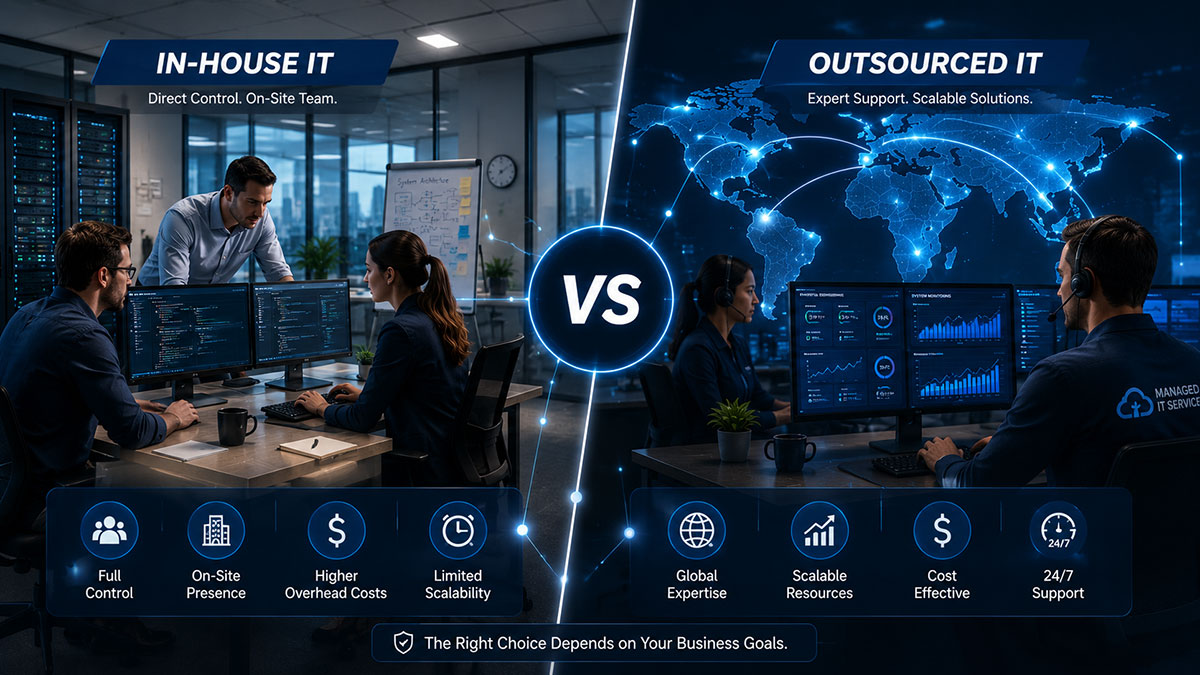
The Core Question: Buy Time or Build a Team?
Every growing business reaches the same inflection point. Your technology complexity has outgrown the founder’s ability to manage it personally, but you are not sure whether to hire an internal IT person, a team, or to engage an external managed IT services provider.
The True Cost of In-House IT
Salary and Compensation
A competent mid-level IT generalist in India’s tier-1 cities commands ₹8,00,000–₹15,00,000 per year in base salary. A senior IT manager or systems architect ranges from ₹18,00,000–₹35,00,000.
Hidden Employment Costs
Beyond salary, employers must account for: employer provident fund contributions (12% of basic salary), gratuity provisions, health insurance, performance bonuses (typically 10–20% of salary), annual training and certification costs (₹50,000–₹1,50,000 per year), recruitment costs when the person leaves, and productivity loss during the 3–6 month onboarding period.
The Coverage Gap
A single in-house IT person cannot provide 24/7 coverage. They take holidays. They get sick. When they resign, you have a coverage gap of weeks to months while you recruit, hire, and onboard a replacement.
The True Cost of Managed IT Services
For a 20-person business, monthly managed IT costs typically range from ₹40,000–₹1,00,000 depending on the service scope — covering 24/7 monitoring, helpdesk support, patch management, security management, and strategic IT advisory.
What Managed IT Actually Delivers
A managed services provider (MSP) gives you access to a team of specialists — network engineers, security analysts, cloud architects, helpdesk technicians — for a fraction of the cost of hiring each individually.
The 24/7 Advantage
NetNovaz provides round-the-clock monitoring and an on-call response capability as standard. Issues are detected and often resolved before they affect users. This proactive model moves from reactive break-fix (expensive, unpredictable) to predictive maintenance (fixed cost, lower total impact).
Use Cases: When Each Model Wins
When In-House IT Wins
In-house IT makes most sense when: your organisation has specialised, proprietary technology that requires deep institutional knowledge; regulatory requirements mandate certain IT functions be performed by direct employees; your scale is large enough to justify specialist hires (typically 150+ employees in IT-intensive industries); or you have a CTO/IT director who manages a hybrid team.
When Managed IT Services Wins
Managed IT services are typically the better choice when: you employ fewer than 150 people; you need 24/7 coverage; your IT requirements span multiple specialisms; you have experienced rapid growth; or you need predictable monthly IT costs for budgeting.
The Hybrid Model: Best of Both Worlds
An increasing number of successful businesses use a hybrid model: a single internal IT manager or director who owns vendor relationships and strategic decision-making, supported by an MSP for 24/7 operational coverage and specialist expertise.
Frequently Asked Questions
How do I know if my business is ready to outsource IT?
Signs include: IT issues are regularly affecting business productivity, you are spending too much time on IT management, you have experienced a security incident or near-miss, or you are planning significant growth that your current IT setup cannot support.
What is a managed IT services SLA?
An SLA (Service Level Agreement) defines the performance commitments your MSP is contractually bound to meet — including response times for different severity incidents, uptime guarantees, and the remedies available if those commitments are not met.
Can I switch back to in-house IT after outsourcing?
Yes, though transitions require planning. Reputable MSPs maintain comprehensive documentation of your IT environment, which makes a future transition manageable. Avoid providers who create artificial lock-in.
What is a virtual CTO (vCTO) service?
A virtual CTO service provides strategic technology leadership — technology roadmap planning, vendor evaluation, digital transformation strategy — from an experienced CTO-calibre professional on a part-time, fractional basis.
How quickly can NetNovaz onboard a new managed IT client?
NetNovaz’s standard onboarding process takes two to four weeks and includes a comprehensive IT environment audit, documentation of all systems and configurations, deployment of monitoring and management agents, and a technical handover meeting.