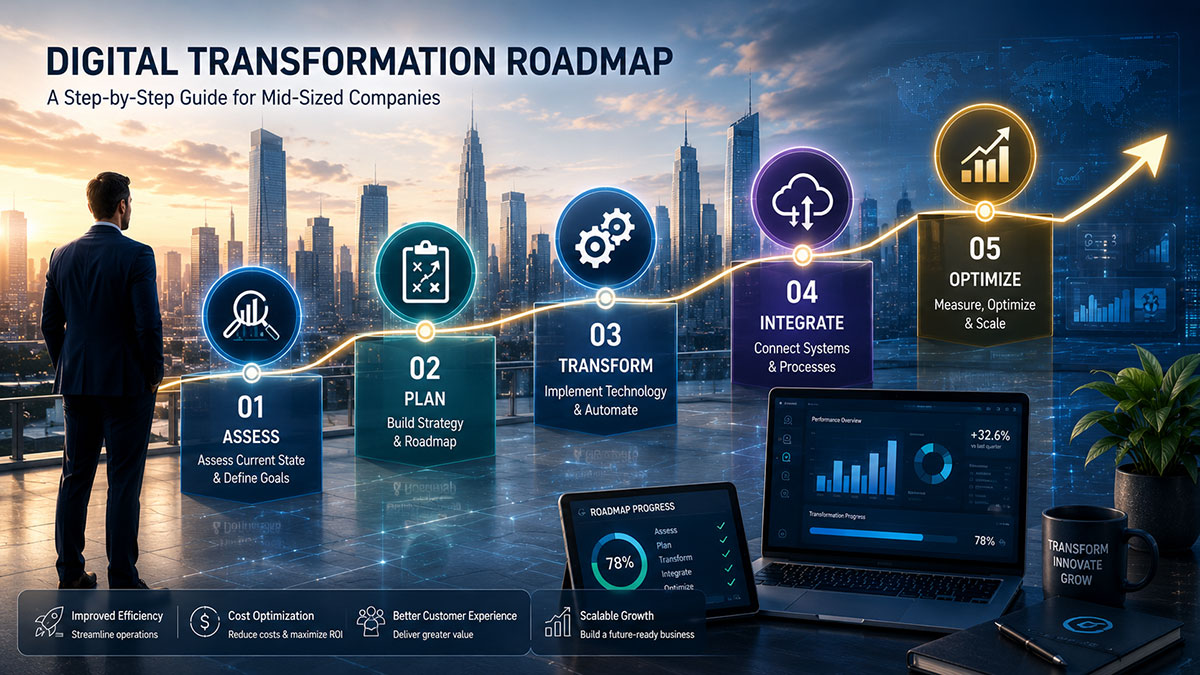
Digital Transformation Roadmap: A Step-by-Step Guide for Mid-Sized Companies
What Digital Transformation Actually Means (Not Buzzwords)
For a mid-sized company in 2026, digital transformation means systematically replacing manual, paper-based, or legacy technology processes with digital systems that produce measurable improvements in speed, cost, quality, or customer experience — and building the organisational capabilities to keep improving continuously.
Why Now Is the Critical Moment
AI-powered competitors can automate processes that previously required skilled human labour. Cloud-native competitors operate with IT cost structures that legacy businesses cannot match. The window to close the competitive gap is narrowing. Businesses that begin their transformation programmes in 2026 will have meaningful advantages over those that wait until 2027.
Phase 1: Digital Audit and Gap Analysis
A comprehensive digital audit covers: existing technology inventory, process mapping, data inventory, digital skills assessment, and competitive benchmarking.
Common Findings from Digital Audits
The most common findings include: data siloed across incompatible systems, manual processes that consume significant staff time and introduce errors, legacy systems that are expensive to maintain, and significant variance between documented processes and how they actually work in practice.
Phase 2: Defining Business Objectives and KPIs
Digital transformation without clear business objectives is technology investment without direction. Objectives should be specific and time-bound.
“Reduce customer onboarding time from 14 days to 3 days within 18 months.”
“Reduce manual data entry in the finance function by 80% within 12 months.”
Phase 3: Technology Selection — Cloud, AI, and Automation
Technology selection is where digital transformation projects most commonly fail — not because businesses choose bad technology, but because they choose good technology that is misaligned with their specific objectives.
Cloud Infrastructure
Almost every mid-market digital transformation programme runs on cloud infrastructure. The scalability, cost model, and managed service ecosystem of AWS, Azure, and Google Cloud make them the natural foundation for modern business technology stacks.
AI and Machine Learning
AI capabilities are now embedded in mainstream business platforms — Microsoft Copilot in Microsoft 365, AI-powered analytics in Salesforce, intelligent automation in ServiceNow. Mid-market businesses need to identify which existing AI features in their current platforms are activated.
Process Automation
Robotic process automation (RPA) and workflow automation tools (Microsoft Power Automate, Zapier, Make) can eliminate significant manual process overhead in areas like invoice processing, data entry, and reporting — with implementation timelines measured in weeks, not months.
Phase 4: Change Management and People Strategy
Technology implementation is the easy part. McKinsey research consistently identifies change management failure as the primary reason that 70% of digital transformation programmes underdeliver.
Change management requires: clear executive sponsorship, early involvement of end users, realistic training investment, and a change champion network in each department.
Phase 5: Implementation, Measurement, and Iteration
Implement in sprints. Measure outcomes against the KPIs defined in Phase 2. Share results broadly — positive outcomes build momentum and organisational confidence. Adjust priorities based on what is working. Eliminate initiatives that are not delivering value regardless of sunk cost.
Case Study: 200-Person Manufacturing Company
A mid-sized component manufacturer engaged NetNovaz for a comprehensive digital transformation programme over 18 months: cloud migration (months 1–4), ERP consolidation (months 5–10), process automation for quality documentation (months 11–14), and real-time analytics dashboard deployment (months 15–18).
Outcomes: 45% reduction in IT infrastructure costs, 60% reduction in compliance documentation time, and a 12% improvement in on-time delivery performance within six months of dashboard launch.