AI in Business: 7 Ways Artificial Intelligence is Transforming Operations in 2026
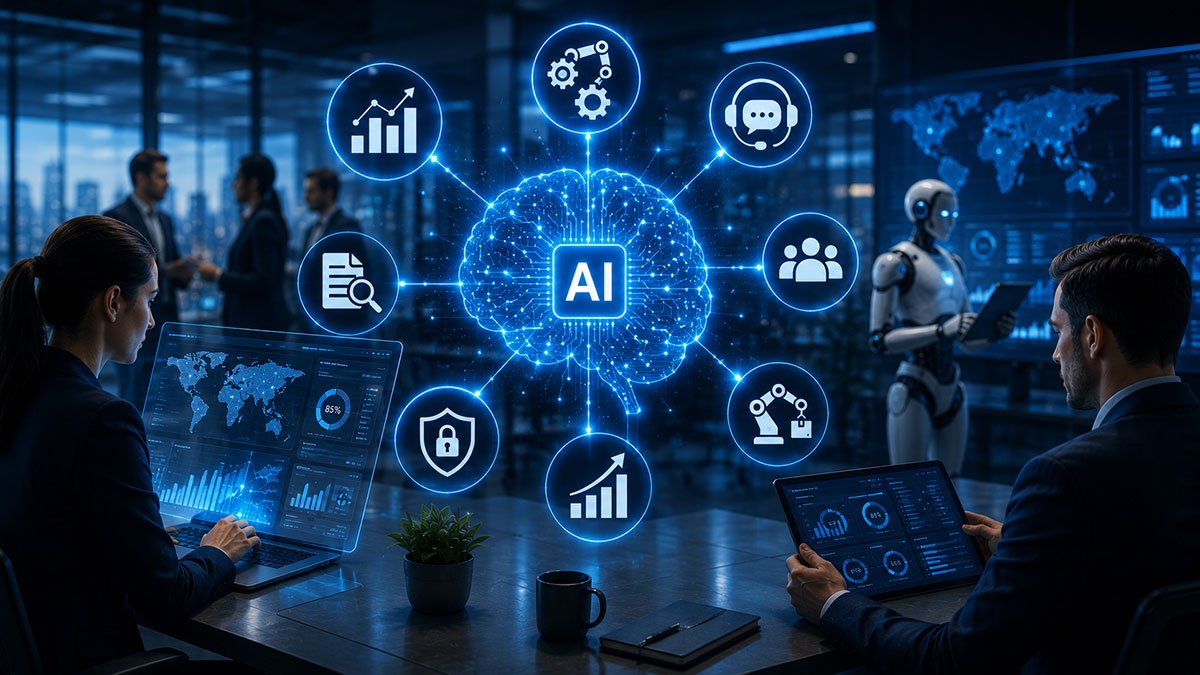
AI in 2026: Beyond the Hype, Into the Workflow
In 2026, artificial intelligence is not a future technology — it is embedded in the platforms your business already uses. Microsoft Copilot is in Microsoft 365. Einstein AI is in Salesforce. Gemini is in Google Workspace. The question is no longer whether to use AI; it is which applications deliver genuine ROI.
7 Ways AI is Transforming Business Operations
Use Case 1: AI-Powered Customer Support
Modern AI customer support tools (Intercom’s Fin AI, Zendesk AI, Freshdesk Freddy AI) are trained on your product documentation, help articles, and historical support tickets. Business impact: 40–70% reduction in first-response time, 30–50% reduction in support ticket volume reaching human agents, and improved customer satisfaction scores.
Use Case 2: Predictive Analytics for Inventory and Demand
AI demand forecasting models analyse historical sales patterns, seasonality, promotional effects, and external signals to produce statistically optimised inventory recommendations. Business impact: 20–30% reduction in excess inventory, 15–25% reduction in stockouts.
Use Case 3: AI-Driven Cybersecurity Threat Detection
Microsoft Sentinel, CrowdStrike Falcon, and Darktrace use machine learning to establish normal behaviour patterns for users, devices, and network traffic, then flag deviations for investigation. Organisations using AI-powered security tools detect breaches significantly faster — industry average dwell time under 24 hours, versus weeks for traditional detection.
Use Case 4: Automated Financial Forecasting and Anomaly Detection
AI-powered FP&A tools automate data aggregation and apply machine learning to identify anomalies, forecast variances, and surface insights that manual analysis would miss. Finance teams report 50–70% reduction in time spent on monthly close processes.
Use Case 5: AI in HR — Recruitment, Retention, and Workforce Planning
AI-powered recruitment tools improve the quality and speed of hiring by analysing application materials at scale, identifying patterns that correlate with high performance, and reducing cognitive bias in initial screening. The average cost of a bad hire at mid-management level exceeds ₹10,00,000.
Use Case 6: Marketing Personalisation at Scale
AI-powered marketing operates on individuals — each customer receives communications and offers tailored to their specific behaviour, preferences, and purchase history. Personalised email campaigns consistently outperform generic campaigns by 2–6x on open rates and click-through rates.
Use Case 7: Intelligent Process Automation (IPA)
IPA combines RPA with AI capabilities — natural language processing, machine learning, computer vision — to automate processes that involve unstructured data, exceptions, and judgement. IPA implementations typically deliver 60–80% reduction in processing time and 90%+ accuracy improvement for the automated portion of workflows.
Getting Started: Your AI Readiness Assessment
Before implementing any AI initiative, assess your organisation’s readiness across three dimensions: data quality, process clarity, and change readiness.
Frequently Asked Questions
Will AI replace our employees?
For most SMBs, AI augments employees rather than replacing them. AI handles high-volume, repetitive tasks — freeing people for higher-judgement work. Businesses that implement AI effectively typically redeploy affected employees rather than eliminate roles.
How much does AI implementation cost for an SMB?
Many AI capabilities are already included in your existing software subscriptions — Microsoft Copilot in Microsoft 365, AI features in Salesforce, Google Workspace AI. Activating these costs nothing beyond existing licences. Standalone AI tools typically range from ₹5,000–₹50,000 per month for SMB-scale deployments.
What data do I need to start using AI in my business?
It depends on the use case. AI customer support tools can work from your existing documentation and knowledge base. AI demand forecasting needs 12+ months of structured sales and inventory data. AI cybersecurity tools baseline from your existing network and endpoint activity.
How do I measure the ROI of an AI implementation?
Define baseline metrics before implementation, then measure the same metrics at 30, 60, and 90 days post-launch. For customer support AI, track first-response time and ticket deflection rate. For demand forecasting AI, track inventory turnover and stockout frequency.
Is our business data safe when using AI tools?
Enterprise AI tools from Microsoft, Google, and Salesforce include contractual commitments that your data is not used to train their models. Consumer AI tools (ChatGPT free tier, etc.) may use input data for training. Always review data processing terms before sharing business data with any AI platform.