AI Automation in Digital Marketing: A 2026 Playbook for Indian Businesses
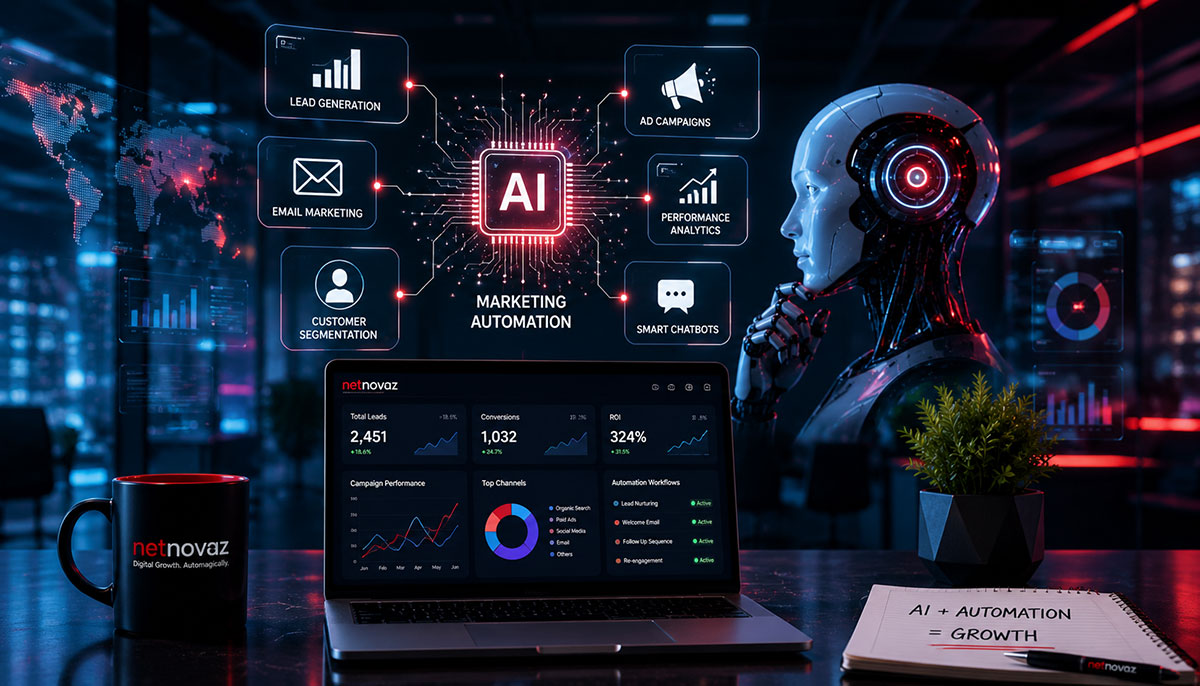
Two years ago, AI in Indian digital marketing mostly meant a chatbot that could answer three FAQs badly. In 2026 that has changed completely. Business owners across Delhi NCR and beyond are now running AI agents that qualify leads while they sleep, automation workflows that sync ad performance data into a CRM without a spreadsheet in sight, and content pipelines that produce and publish on a schedule no human team could sustain manually.
The businesses seeing genuine returns are not the ones chasing every new AI tool that launches. They are the ones who picked two or three high-friction points in their marketing operation and automated those properly. This playbook walks through what AI automation actually looks like in practice for an Indian SME in 2026, and how to evaluate whether it’s worth adopting for a specific business.
What ‘AI Marketing Automation’ Actually Means in 2026
The term gets used loosely, so it helps to separate it into three distinct layers. The first is workflow automation — tools like n8n that connect different systems (a website form, WhatsApp, a CRM, an ad account) so data moves between them without manual entry. This layer alone eliminates a huge amount of the busywork that eats a marketing team’s week.
The second layer is AI decision-making layered on top of that automation — an AI agent that doesn’t just move data around but reads it, reasons about it, and takes an action: qualifying a lead as hot or cold, drafting a personalised reply, or flagging which ad creative is underperforming and should be paused. The third layer is AI content generation — using models to draft ad copy, blog outlines, or social captions at a speed a human copywriter cannot match, always with a human doing final review before anything goes live.
Where AI Automation Delivers Real ROI for Indian SMEs
Lead qualification is the single highest-ROI use case Netnovaz sees consistently. A website chat widget or WhatsApp entry point connected to an AI agent can ask the right qualifying questions immediately — budget, timeline, location, requirement — and route only genuinely warm leads to the sales team, instead of the team spending half their day on tyre-kickers.
Reporting automation is a close second. Instead of a team member manually pulling numbers from Google Ads, Meta Ads, and Google Analytics into a spreadsheet every Monday, an n8n workflow can pull that data automatically and push a formatted summary straight into a WhatsApp group or email inbox. The time saved is real, but the bigger benefit is that decisions get made on Tuesday’s data instead of last month’s.
A Real n8n Workflow Example: Lead-to-CRM Automation
Consider a typical setup: a lead fills out a form on the website, or messages on WhatsApp. Without automation, someone has to notice that lead, copy their details into a CRM, and reply — often hours later, by which point the lead has already messaged three competitors.
With an n8n workflow, the moment that lead comes in, the workflow can validate their phone number and location, enrich the record with any data already known about them, create or update a CRM entry, trigger an instant AI-drafted WhatsApp or email reply, and notify the right salesperson — all inside a minute or two, with zero manual steps. Businesses that implement this typically see a meaningful lift in lead-to-conversation conversion simply because the response time drops from hours to seconds.
Where to Be Cautious: AI Automation Pitfalls
The most common mistake is automating a broken process. If the underlying sales script or offer isn’t converting, automating the outreach around it just produces bad results faster and at greater scale. It’s worth fixing the process manually first, proving it works, and only then automating it.
The second pitfall is going fully automated with zero human checkpoint on anything customer-facing, particularly around pricing, refunds, or complaints — an AI agent should escalate these to a human rather than attempt to resolve them independently. The third is data hygiene: automation moves bad data just as efficiently as good data, so a workflow built on a messy, duplicate-filled contact list will simply duplicate that mess faster.
How to Get Started Without Overspending
The businesses that succeed with AI automation almost always start small: one workflow, one clear bottleneck, measured before and after. A lead-response automation or a reporting automation are both good first projects because the before-and-after impact is easy to measure in hard numbers — response time, hours saved, or leads converted.
Once that first workflow is proven, it becomes far easier to build the business case for expanding into content automation, ad optimisation automation, or a full AI-driven WhatsApp and website lead qualification system. Most tools in this space, including n8n itself, have generous free or low-cost tiers, which means a proof of concept rarely requires a large upfront budget.