
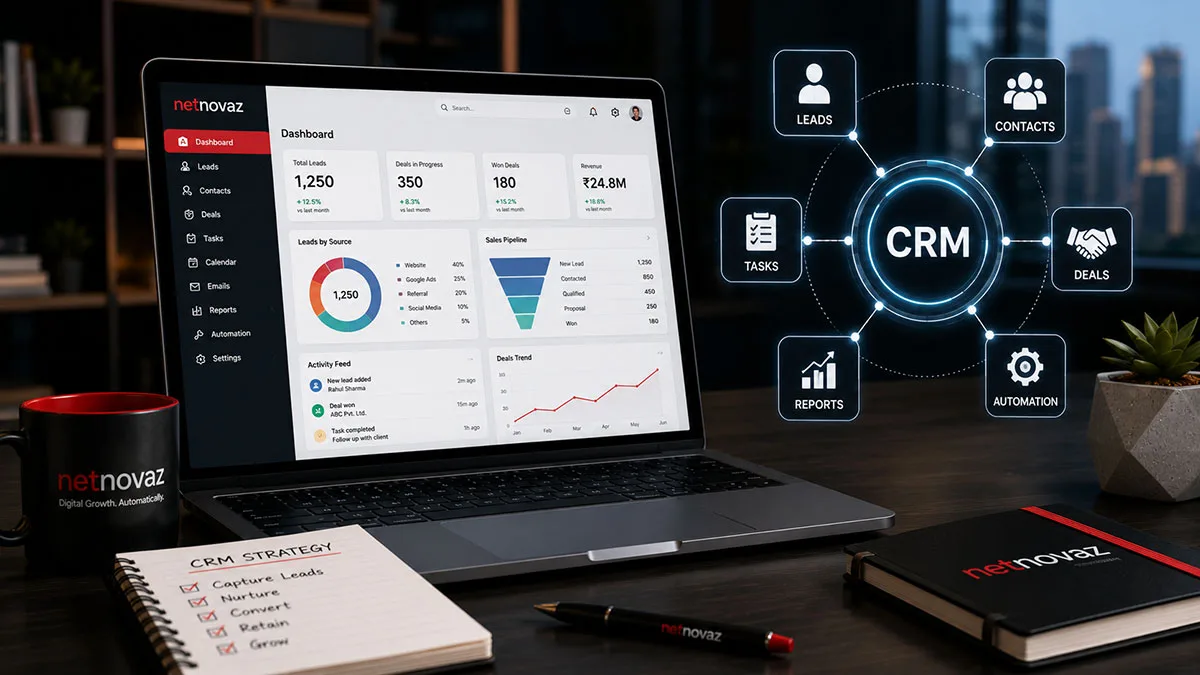
Walk into almost any growing Indian manufacturing firm in Okhla, a logistics agency in Peenya, or a B2B trading house in Surat, and you will hear a familiar story: a promising ₹12 lakh inquiry received via WhatsApp last Thursday was completely forgotten because the sales executive took sick leave. Or worse, your top-performing sales rep resigned on Friday, taking six months of customer negotiations, pricing history, and active follow-up threads with them inside their personal phone.
In 2026, Indian Small and Medium Enterprises (SMEs and MSMEs) face an unprecedented commercial shift. Customer acquisition costs on Google and Meta Ads have climbed 35% year-on-year, B2B buyers expect instant quotes over WhatsApp, and managing customer pipelines across disconnected Excel sheets is no longer just messy—it is actively hemorrhaging revenue.
But does that mean every Indian business with 5 to 50 employees should rush to purchase expensive foreign software like Salesforce or HubSpot? Absolutely not. Over 60% of CRM software implementations in Indian SMEs are abandoned within 9 months because founders buy software built for Silicon Valley account executives rather than Indian operational realities. This guide cuts through the marketing noise to give you an honest, practical blueprint for deciding if, when, and how your business needs a CRM in 2026.
Key Takeaway for Decision Makers
A CRM is not a magic wand for broken salesmanship. If your business doesn’t have a clearly defined step-by-step sales process on paper, installing CRM software will only automate chaos. Buy or build a CRM only when your lead flow exceeds what a single disciplined person can track, when WhatsApp customer data is walking out the door, or when manual quote generation is causing you to lose deals to faster competitors.
Average lead leakage in Indian SMEs relying strictly on unlinked spreadsheets
Time wasted per sales executive weekly on duplicate reports & manual quote follow-ups
Of Indian B2B buyers now demand quotation and catalog interaction over WhatsApp
Higher deal closing probability when initial response happens within 15 minutes of inquiry
The Anatomy of Sales Pipeline Leakage in Indian SMEs
To understand whether you need a Customer Relationship Management (CRM) platform, you first need to audit where your company is quietly losing money. In most Indian enterprises without a centralized system, customer communication does not live in an institutional database—it lives in fragmented siloes:
Inquiries pour in from your website contact forms, Meta lead generation campaigns, Google search ads, IndiaMART, TradeIndia, and direct referrals. Without automated routing, someone has to copy-paste numbers into a master spreadsheet. Some numbers get passed to a salesperson via personal WhatsApp message. The salesperson calls two days later; the client has already signed with a competitor who answered within ten minutes.
- The Black Hole of Inquiries: Between 30% and 45% of incoming digital leads are never followed up more than once because sales reps prioritize only immediate hot prospects.
- Personal Device Hostage: Client interaction logs, negotiated discounts, payment terms, and project specifications stay locked in an individual executive's WhatsApp chat backup.
- The Multi-Version Excel Nightmare: Files named Leads_2026_Final_v2_Edited_Tanveer.xlsx circulating on Google Drive with conflicting notes, overwritten cells, and zero change tracking.
- Blind Spot on True Marketing ROI: You spend ₹1,50,000 monthly on digital campaigns but cannot pinpoint which specific ad campaign generated actual paid GST invoices versus frivolous inquiries.
5 Signs Your Indian Business Has Outgrown Excel & Google Sheets
Spreadsheets are phenomenal tools. In fact, every startup and micro-enterprise should start with Google Sheets. It is free, universally understood, and instantly adaptable. However, spreadsheets have a structural breaking point. Here are five unmistakable indicators that your business has crossed that threshold:
1. You Employ More Than 3 Sales Executives
When you have one or two sales reps, you can sit with them every evening for a 15-minute sync. Once you scale to four or five people handling inbound and outbound sales across different territories or product verticals, accountability vanishes. Reps begin cherry-picking leads, blaming each other for lost opportunities, and hiding delayed follow-ups behind vague verbal updates.
2. Follow-Up Consistency Has Collapsed
Study after study demonstrates that 80% of B2B transactions require 5 to 8 follow-up interactions before contract signing. Yet, in the typical Indian SME, over 70% of prospects are contacted once or twice and then forgotten. A CRM forces scheduled next-step tasks, automated calendar reminders, and notification pings before a lead goes cold.
3. Customer Quotes Take More Than 3 Hours to Dispatch
If your sales team has to open Microsoft Word or Excel, search old folders for pricing templates, re-calculate GST calculations manually, convert to PDF, and then email it to the prospect, you are losing deals. Modern CRMs generate branded, GST-compliant quotations in under two minutes with automated discount limits and instant WhatsApp delivery.
4. You Lose Historical Knowledge When Staff Resigns
If the departure of a sales manager causes panic because nobody knows the pending status of twenty ongoing accounts or what was promised to an existing customer, your company is vulnerable. A CRM turns customer relationships into institutional company assets rather than individual employee possessions.
5. Management Spends Hours Compiling "Daily Status Reports"
If you as a promoter, founder, or director must spend two hours every evening asking: "How many calls were made today? How many quotes were sent? What is our projected closure for the month?", you are wasting leadership bandwidth. A CRM provides a real-time visual dashboard accessible on your smartphone at any moment.
The India-Specific CRM Landscape in 2026: 4 Ground Realities
Buying software in India is fundamentally different from buying software in North America or Western Europe. Off-the-shelf Western platforms frequently stumble because they fail to account for how Indian commerce actually operates on the ground:
Reality 1: WhatsApp is the Real Sales Operating System
In India, business transactions happen on WhatsApp. Decision-makers rarely reply to lengthy email sequences; they respond to WhatsApp messages, voice notes, and PDF brochures sent directly to their phones. A CRM in 2026 that lacks native Meta WhatsApp Business API integration—enabling official Green Tick verification, automated greeting sequences, pre-approved notification templates, and chat archiving—is virtually obsolete for Indian sales teams.
Reality 2: Accounting Sync with Tally, Busy, or Zoho Books
Sales does not exist in isolation from accounts. When a deal is marked "Closed-Won," what happens next? In a disconnected setup, an accounts clerk manually re-types customer billing details, PAN, and GSTIN into TallyPrime or Busy. Typos occur, tax invoice generation is delayed, and dispatch gets stalled. In 2026, your CRM must bridge the gap between sales pipeline and Indian GST accounting software via automated webhooks or database connectors.
Reality 3: Mobile-First Adoption for On-Ground Field Teams
Sales representatives visiting manufacturing units in Faridabad, client offices in Gurugram, or retail distributors in Chandni Chowk do not carry laptops to open desktop dashboards. They require a lightweight, mobile-responsive interface where they can log meeting notes via voice dictation, upload site visit photos, check-in via GPS geo-tagging, and update deal stages with two taps.
Reality 4: The Dangerous Trap of Foreign Per-Seat Dollar Billing
Many Indian founders start a free trial of a popular US-based CRM, only to discover a year later that license upgrades, mandatory add-ons, and currency conversion fees cost $60 to $120 per user per month plus 18% foreign transaction GST. For a 12-person team, that translates to over ₹10,00,000 annually in recurring SaaS fees—money that rarely translates into proportionate top-line revenue for an Indian SME.
| Evaluation Metric | Google Sheets / Excel | Off-the-Shelf SaaS CRM | Custom-Built Enterprise CRM |
|---|---|---|---|
| Upfront Cost | ₹0 Free | Low (₹1.5k–5k/user/mo) | Moderate One-Time Fee |
| 3-Year Total Cost (15 Users) | ₹0 | ₹8,00,000 – ₹22,00,000+ | Predictable (Zero Per-Seat Fees) |
| WhatsApp API Integration | None / Complex Webhooks | Third-party Plugin Fees | Native & Custom Automated |
| Tally / Busy GST Sync | Manual Double Entry | Requires Fragile Connectors | Direct API / XML Integration |
| Workflow Customization | Limited to Formulas | Rigid Preset Templates | 100% Tailored to Your Process |
| Data Ownership & Privacy | Easy to Copy / Export | Hosted on Multi-Tenant Cloud | 100% Private Dedicated Server |
When Your Indian SME Actually Does NOT Need a CRM
In an era where every tech vendor insists you need artificial intelligence and automated pipelines, intellectual honesty is critical. There are numerous legitimate scenarios where buying or building a CRM is an unnecessary distraction and expenditure:
- Solo Consultants & Boutique Agencies: If you manage fewer than 10 to 15 high-value corporate clients annually and you are personally involved in every conversation, a disciplined Notion workspace or Google Sheet combined with calendar reminders is more than sufficient.
- Pure Walk-in Retailers: If you operate an over-the-counter retail shop or physical showroom with immediate card or UPI payment, a specialized Point of Sale (POS) billing system is what you need, not a B2B pipeline CRM.
- You Haven't Defined Your Sales Process Yet: If your company does not know what constitutes a "Qualified Lead" versus a "Junk Inquiry," or you don't have standardized pricing and quotation terms, technology will not save you. Map the steps on a whiteboard first.
- Zero Management Commitment to Enforcement: If leadership is not prepared to mandate that unlogged deals receive zero commission, the sales team will abandon data entry within three weeks.
The Build vs. Buy Dilemma: When Custom CRM Wins in India
Once you have determined that your business has genuinely outgrown manual tools, you face a pivotal fork in the road: should you subscribe to a standardized SaaS subscription (such as Zoho CRM, LeadSquared, or HubSpot), or should you commission a tailored, custom CRM system designed specifically around your operational workflow?
When Off-the-Shelf SaaS Makes Sense
Standard SaaS tools are excellent when your sales process follows standard textbook B2B sequences: Lead > Discovery Call > Demo > Proposal > Contract. If you have a small team of 2 to 4 people, don't require non-standard industry calculations, and want to be up and running by tomorrow afternoon, a basic SaaS tier is the fastest path forward.
When Custom CRM Delivers 5x Higher Return on Investment
However, many Indian businesses operate with intricate, industry-specific workflows that off-the-shelf software cannot accommodate without clumsy, expensive workarounds:
- Multi-Tier Distribution Networks: Manufacturing and FMCG companies dealing with super-stockists, regional distributors, and retail tier pricing with variable credit cycles.
- Complex Quotation Formulas: Fabricators, packaging manufacturers, and interior contractors where quotes depend on raw material weight, fluctuating commodity prices, wastage percentages, and custom finishing coats.
- Uncapped Team Growth Without License Penalties: Custom CRM solutions carry zero per-user subscription fees. Whether you have 10 sales reps or 100 field executives, your software licensing fee remains zero.
- Strict IP & Customer Data Sovereignty: Keep all client lists, negotiated margin margins, and trade secrets hosted on your own private cloud or local servers, protected against third-party SaaS data scraping.
A Practical 5-Step CRM Rollout Roadmap for 2026
If you decide to move forward with a CRM implementation, following this structured rollout roadmap will safeguard your investment and ensure team adoption:
- Step 1: Document Your Sales Stages on Paper First: Define precise milestone definitions. For example: 1. New Lead > 2. Contacted & Requirement Gathered > 3. Technical Feasibility > 4. Formal Quote Dispatched > 5. Under Negotiation > 6. Won / Lost. Keep it under 6 stages.
- Step 2: Consolidate & Clean Your Lead Sources: Audit every channel where customers reach out. Set up automated webhooks so website inquiries, WhatsApp catalog clicks, and portal leads feed into one centralized inbox within seconds.
- Step 3: Keep Required Fields Brutally Minimal: The number one killer of CRM adoption is forcing sales reps to fill out 25 mandatory text boxes after every phone call. Keep mandatory fields strictly to: Contact Name, Mobile Number, Product Category, Next Action Date, and Deal Value.
- Step 4: Establish Strict Response SLAs: Configure automated notifications so if an inbound inquiry is not claimed or acknowledged within 15 minutes during business hours, the team manager receives an alert. Speed to lead is the highest converting lever in 2026.
- Step 5: Replace Verbal Review Meetings with CRM Dashboards: Never ask your team for verbal sales updates again. Conduct your Monday morning sales meetings directly projected on screen from the CRM pipeline. If an inquiry isn't logged in the CRM, it officially doesn't exist.
Frequently Asked Questions (FAQ) for Indian SME Owners
Q1. How much should an Indian SME realistically budget for a CRM in 2026?
For basic SaaS tools, budget approximately ₹1,500 to ₹3,500 per user per month. For a custom CRM development project built by an experienced technology agency like NetNovaz, upfront development typically ranges from ₹75,000 to ₹3,50,000 depending on complexity, WhatsApp integration, and Tally connectors. After deployment, ongoing costs are limited to minimal cloud server hosting, delivering massive long-term savings for teams with 8 or more executives.
Q2. Can a CRM prevent sales representatives from stealing customer contacts when they quit?
Yes. Role-based access control (RBAC) allows administrators to mask raw phone numbers (click-to-call integration), disable bulk CSV exporting, and enforce that all WhatsApp and email communications take place via institutional company numbers. When an employee departs, their system credentials can be revoked in one click with zero loss of conversation archives.
Q3. How long does it take for an Indian SME sales team to fully adopt a new CRM?
With a simplified, mobile-first interface and proper management enforcement, initial team adoption typically takes 2 to 3 weeks. Full habitual adoption—where pipeline forecasts and automated follow-ups run smoothly—generally stabilizes within 45 to 60 days.
Q4. Will a custom CRM require an in-house IT team to maintain?
No. NetNovaz architects custom CRM applications on modern, secure cloud infrastructures (such as AWS, DigitalOcean, or Google Cloud) with automated database backups, SSL encryption, and maintenance support agreements. Day-to-day operation requires only standard web browsers or smartphone apps without any dedicated IT staff.
Leave a Reply
Your email address will not be published. Required fields are marked *